


Custody orders are written for the family you had on the day the judge signed them. Children grow up, parents move, jobs change, and sometimes a schedule that made sense three years ago no longer works for anyone. Georgia law allows a custody order to be changed, but the court will not reopen custody simply because one parent is unhappy with it. Here is how modification works in Georgia and what a judge will be looking for.
The short answer
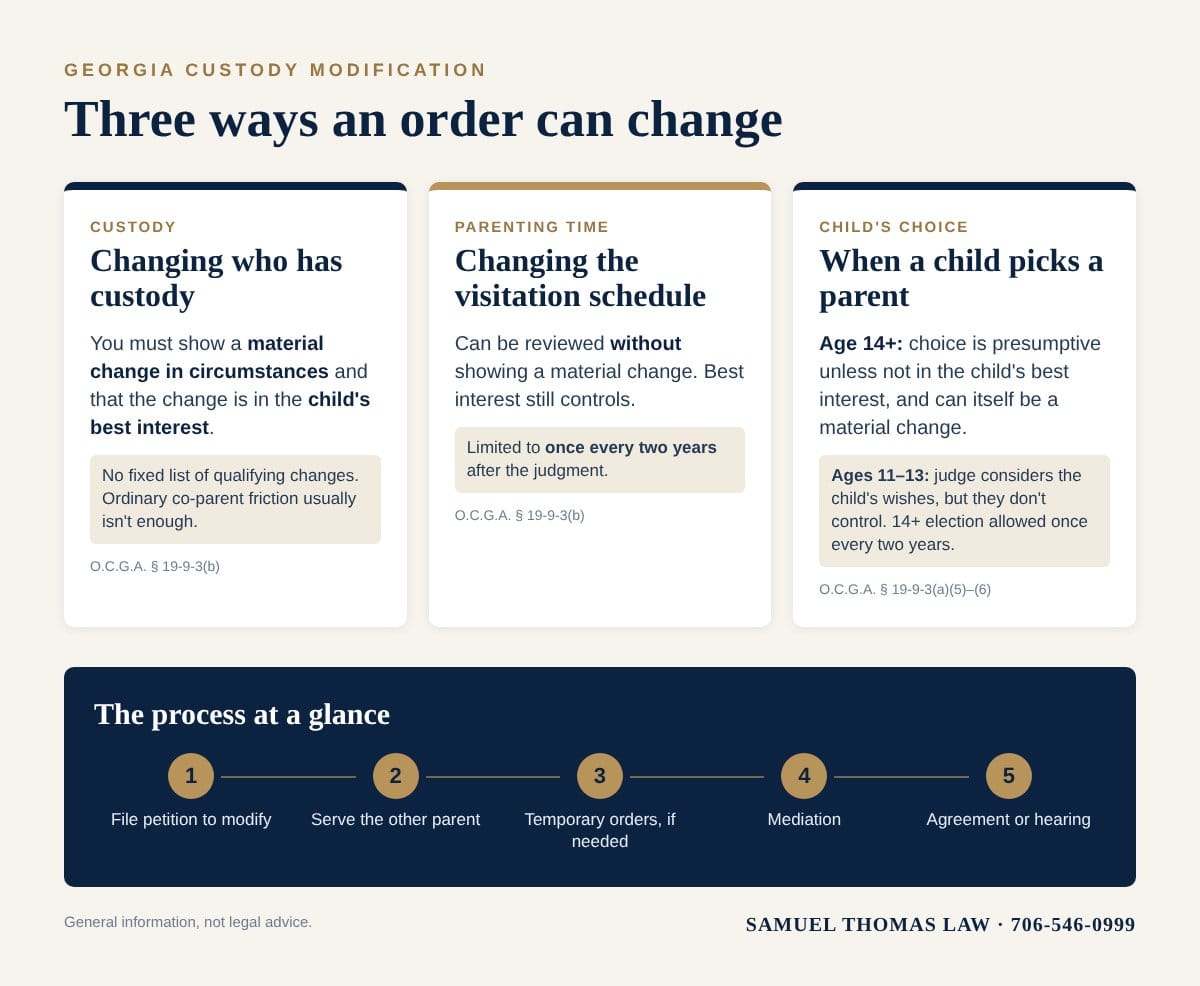
Yes, you can ask the court to change a Georgia custody order. To change custody, you generally must show a material change in circumstances of a parent or the child since the last order, and that the change you are asking for is in the child’s best interest (O.C.G.A. § 19-9-3(b)). Changes to visitation or parenting time follow a somewhat different rule, explained below.
What counts as a “material change in circumstances”?
There is no fixed list. The question is whether something meaningful has changed since the last order that affects the child’s welfare. Situations that often come up include:
- A parent relocating, or planning to relocate, far enough that the current schedule no longer works (see how relocation affects child custody in Georgia)
- Substance abuse, family violence, or unsafe conditions in a household
- A parent repeatedly ignoring the parenting schedule or interfering with the other parent’s time
- A significant change in the child’s needs, such as school, health, or behavioral issues
- A parent’s work schedule changing in a way that affects day-to-day care
- A child aged 14 or older choosing which parent to live with (more on this below)
Ordinary friction between co-parents, or a change that has little real effect on the child, usually is not enough. The judge also does not start from scratch. The existing order is the starting point, and the parent asking for the change carries the burden of showing why it should be different.
Changing visitation or parenting time
Georgia gives parents a little more flexibility when the request is about the visitation or parenting time schedule rather than custody itself. Under O.C.G.A. § 19-9-3(b), visitation and parenting time can be reviewed and modified without showing a material change in circumstances, but that kind of review cannot happen more than once in each two-year period after the judgment is entered. The court still decides based on the child’s best interest.
What if my child wants to live with me?
This is one of the most common questions parents ask, and Georgia law treats it differently depending on the child’s age.
Children 14 and older
A child who is 14 or older has the right to select the parent he or she wants to live with. That selection is presumptive, meaning the court will follow it unless the chosen parent is found not to be in the child’s best interest. The child’s selection can, by itself, count as a material change in circumstances for a modification. However, a child may only make a selection once every two years (O.C.G.A. § 19-9-3(a)(5)).
In practice, the election is usually made through a signed affidavit filed with the modification case. Judges also watch for signs that a child has been pressured or rewarded for choosing one parent, so how the conversation with your child happens matters.
Children 11 to 13
For children between 11 and 13, the judge must consider the child’s wishes and educational needs, but those wishes are not controlling. The judge has complete discretion, may hear the child’s preferences through a guardian ad litem, and the child’s choice does not by itself count as a material change (O.C.G.A. § 19-9-3(a)(6)).
How the modification process works
- Filing. A modification starts with a petition (often called a complaint for modification) filed in the proper county. In most cases, that is the county where the other parent lives if he or she has legal custody.
- Service. The other parent must be formally served and given time to respond.
- Temporary orders. While the case is pending, the judge has discretion to change custody on a temporary basis (O.C.G.A. § 19-9-3(e)).
- Mediation. Many Georgia courts require mediation before a contested hearing. In the Western Judicial Circuit (Clarke and Oconee Counties), mediation is required by standing order.
- Updated parenting plan. Expect to submit a proposed parenting plan reflecting the new arrangement.
- Hearing or agreement. If the parents agree, the agreement can be submitted to the court for approval. If not, the judge decides after a hearing, applying the best interest factors in O.C.G.A. § 19-9-3(a)(3).
The judge may also order one party to contribute toward the other’s attorney’s fees, expert fees, and guardian ad litem fees (O.C.G.A. § 19-9-3(g)).
What to gather before you file
- A copy of your current final order and parenting plan
- A written timeline of what has changed and when
- School records, report cards, and attendance records
- Texts, emails, or co-parenting app messages that show the problem
- Records of missed or late exchanges
- Any police reports, medical records, or other documents that support your concerns
Don’t change the schedule on your own
Even if both parents informally agree to a new schedule, the old court order stays in effect until a judge signs a new one. Withholding the child or ignoring the order can lead to a contempt action and can hurt your credibility in a later modification case. If the arrangement has changed in practice, it is usually worth putting the change in writing through the court.
Frequently asked questions
How long does a custody modification take in Georgia?
An agreed modification can sometimes be finalized in a few weeks. A contested case that goes through mediation and a hearing commonly takes several months or longer, depending on the county and the court’s calendar.
Can my 14-year-old just decide to move in with me?
Your child’s choice carries significant weight, but it still has to be filed with the court and approved. Until a judge modifies the order, the existing order controls.
Do I need a lawyer to modify custody?
You are not required to have one, but modification cases turn on evidence and procedure. A family law attorney can help you judge whether your situation is likely to meet the material change standard before you file.
Talk with an Athens custody attorney
Samuel Thomas Law represents parents in custody and visitation modifications in Athens-Clarke County and throughout Northeast Georgia. If your custody order no longer fits your family, call 706-546-0999 or contact the office to schedule a free consultation. You can also learn more about Sam’s Athens child custody practice.
This article provides general information about Georgia law and is not legal advice. Reading it does not create an attorney-client relationship. Every case depends on its own facts.